Why would you want to take a picture of that ratty, banged up car?
I've had repeated conversations based upon variations of this theme. For the longest time I didn't have a good answer. I still might have the perfect reply but at least I now have given it some thought.

I didn't set out to take pictures of parked cars, it just sort of happened. I wanted to make photography part of my daily routine so I carried a camera with me everywhere and tried to make at least one picture a day. Even with the best of intentions it is often difficult to fit decent blocks of time to practice your art that fit around the schedule imposed by a 'real' 9-to-5 job, and the other demands, responsibilities and pleasures of a modern life. I realized that to succeed I would have to grab 5 minutes here and there, where ever I could find them if I wanted to make picture taking a daily habit. If I couldn't find anything better to shoot I would often just take a deliberate detour of a block or two on my way to get coffee and I'd shoot whatever I encountered en route.
Cars parked on the street are the low-hanging fruit. It doesn't matter where you find yourself in the modern world, when you walk out into it you will encounter cars. When you walk out into that world with your camera in hand it is hard to avoid getting them in your frame; if you have petrol-head tendencies it's harder still not to make them your subjects. Five years ago I started to notice a thread of parked cars running through some of my daily shots so I began to gather them together. While I didn't really go out of my way to find new subjects, when I found myself in a new place or neighborhood I would look on the streets at the kind of cars in that habitat. My wife has grown accustomed to me suddenly pulling our own car to the curb while we are out so that I can run back and bag some rusty treasure I just spotted – these days she even scans the roadside and brings potential subjects to my attention.

The cars portrayed in million dollar ads speed down empty, perfectly twisty roads in air-brushed perfection. New, pampered, expensive cars don't usually slum it on the street; instead they journey from suburban garages to valet-serviced venues. These are not the cars I am interested in. The cars that I look for left the showroom many years ago.
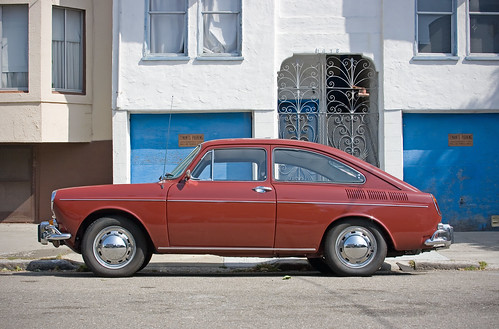
These cars have a utilitarian beauty; a pickup with war wounds; an un-restored, rusty muscle car; a filthy roadster covered in brake-dust and splattered in bugs; a 20 year old RV that is currently someone's home. These are the cars you find parked on the street. They are not unloved, far from it, but they are valued for what they can do not for the status they bestow on their owner.
The conceit of this project is in word Typology of the collection's title. Typology suggests a neutral, scientific and clinical approach to one's subject but I am not going to pretend that my subjects are a typical cross-section of San Francisco's cars – if only that were true being stuck in traffic would be a much more aesthetically appealing possibility. If this were a true field guide I would have to include a lot more pictures of Camry's, Saturn's and mini-vans; overly-popular models that are more of an appliance than a true automobile. The cars I feature are simply the ones that catch my eye. Sometimes the pictures are not even about the cars but the background in which they are located; my adopted home town, San Francisco.
In some ways San Francisco is the main subject of this collection. It makes for an ideal environment for this photographic pursuit. The climate is mild enough that we never put salt on the roads so cars can go thirty years before you see any evidence of tin-worm. The weather is also variable enough to provide a photographer with a variety of lighting conditions and choices, often four-season's worth in a day. The city is also amazingly diverse which is reflected in its population, both human and automotive. Imports are as common as American models. Rusty pickups park next to band new BMWs, Hummers by Smart Cars, well-loved muscle cars by tricked out Civics. The cars on the street reflect the city's populous. This diversity also extends to the neighborhoods that make up this compact town. These neighborhoods provide the sets and backdrops to show off the cars which are the stars of this collection. Shooting cars in the Haight or the Mission is almost too easy but the Avenues or out by the Golden Gate Park and Highway 1 at the Ocean can be just as productive. After all culture, beauty and art and not the sole preserves of the young, the monied or the hipsters and a clapped out 70's station wagon can be as visually stimulating as a band new Ferrari in the right light and the right environment.
If you know how to read it there
is a visual narrative parked on the street's of San Francisco. It tells the
story of a changing American dream; a tale of the cultures and movements that
have been incorporated into late-American history. You can see a narrative
of environmental concerns, rises and falls in the economy, advances in technology
and evolving ideas of beauty, 'cool' and aesthetics. The history of America
is written by the cars parked on its streets but it is not a static history;
everyday is just a snapshot – a portrait of the here and now that can
never be repeated. As cars from the 50s and 60s devolve beyond repair due
to the abuse sustained from years living on the streets cars from more recent
decades take their parking spots and the picture changes. The great Americana
automobiles we take for granted today will be gone tomorrow with cars we think
are impossibly new today, taking their place tomorrow. The wheels turn and
the story evolves.
Each individual car has a finite life just as each of us. The bumps, scrapes
and mileage of everyday life combined with the slow erosion of iron back to
more primitive compounds when exposed to oxygen and water means that it is
only a matter of time before the factory-fresh, new car is sent to the junk
yard and crusher. Metal rusts, rubber hardens, paint oxidizes and chrome pits.
Most new cars are babied in a garage so the cars we see living on the streets
are usually, at their youngest, middle aged. For some, life on the streets
is their last stop before a tow to the breakers. For others they still have
decades of useful life ahead of them. A rare few will be selected for restoration
and a pampered retirement. Each has a life story to tell.
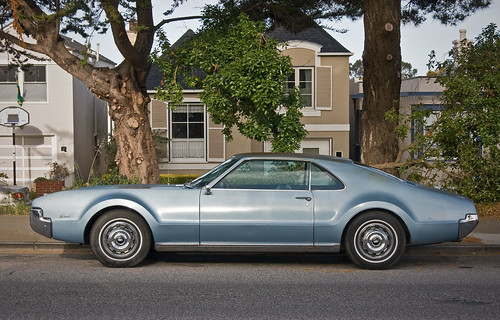
This collection of pictures is also a simple celebration and I am not trying to impose some artificial gravitas upon the collection by intellectualizing my motivations for making these pictures. Since the invention of the modern photographic monograph by Robert Frank the accepted syntax has been lots of white space for the images to 'breathe'. I wanted to convey the congestion and busyness of modern life so I have often laid out many images per page with repeating and conflicting patterns, shapes and colors. It is no accident that the resulting density of images resembles a car trader's free paper; to reflect their subjects I did not want the images to be made overly-precious by being isolated by bank pages and generous borders – in contrast I wanted the forms and chaos to crowd in on my viewer.
In the end I take these pictures because something inexplicable appeals to my eye and I want to share what I see. The right car, parked in a the perfect location is an unexpected thing of beauty and that is the simple premise of this collection.